
BANDUNG, unpas.ac.id – After the issuance of Law No. 1/ 2020 regarding the Omnibus Law, socialization for business entrepreneurs is relatively in minimum state. In fact, there are points of changing the rules that are considered capable of boosting the development of the Micro Small Medium Enterprises (Usaha Mikro Kecil Menengah, UMKM) and cooperative.
Seeing the urgency of accelerating the implementation of the Law among Micro, Small, and Medium Enterprise, Unpas Community Service Institution (Lembaga Pengabdian Masyarakat, LPM) collaborates with Indonesian International Labor Organization (ILO) through the SCORE project to develop a Handbook of Easily Doing Business for Micro Small Medium Enterprises (lit. Buku Pedoman Kemudahan Berusahan bagi Pelaku UMKM).
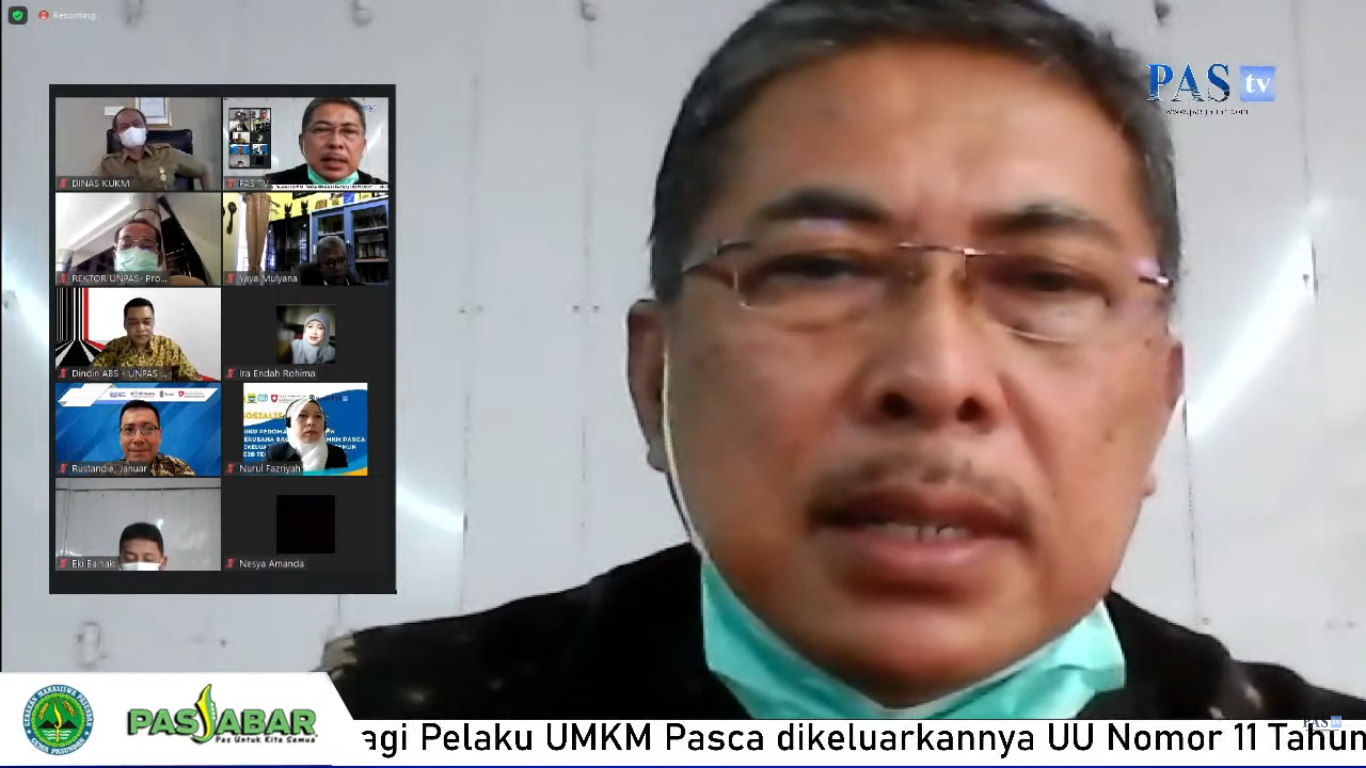
The handbook is socialized in the online Focus Group Discussion (FGD) presenting a keynote speaker who are the expert in the field to give suggestion regarding the book (since it has been completely finished yet), that are Head of Bandung KUKM Drs. Atet Dedi Handiman, Employment Practitioner Sugeng Prayitno, SH., MH., Public Policy Expert Dr. H. Yaya Mulyana Abdul Azis, M.Sc., Legal Expert Hj. Irma Rachmawati, SH., MH., Ph.D., and Dr. Dindin Abdurohim Brata Sonjaya, MM., M.Sc.
The event was officially opened by Rector of Unpas Prof. Dr. Ir. H. Eddy Jusuf Sp., M.Si., M.Kom., IPU. He appreciated the effort taken by LPM, since the Law of Cipta Kerja itself contained few regulations regarding employment system and is important to be informed to the UMKM entrepreneurs.
“In the Law of Cipta Kerja, there are simplification of business licensing, investment requirements, labor rights and obligations, as well as the convenience and protection of MSMEs, so people running on the business need to know it first before implementing it. I hope this socialization could be followed up, utilizing social media by creating creative content,” he said on Tuesday (June 29th, 2021).
Head of Unpas LPM, Dr. Ir. H. Asep Dedi Sutrisno, MP., conveyed that the socialization aimed to complete the handbook before it gets finalizes. Therefore, Unpas LPM collaborates with ILO and other experts, as well as practitioner in legal, employment, and public policy fields to make it possible for UMKM entrepreneurs understand the Law substance as optimal as possible.
“Both Unpas LPM and ILO create the handbook for UMKM entrepreneurs to be able to use the Law’s benefits for their business continuity. By this FGD, we hope that what the keynote speakers conveyed to us could be well-informed and understood by the entrepreneurs,” he explained.
Briefly, draft of the handbook contains 4 main points which are also the main classic problems, namely permission, funding, partnering and wages. The other problems include the explanation of MSMEs, the contribution of UMKM, the role of UMKM in Indonesia, the criteria for UMKM capital, examples of MKM and UMKM, the definition of Cipta Kerja Law, the aspects regulated in Cipta Kerja Law, and its benefits for UMKM entrepreneur (Reta)*
